
Just like the rest of them... Christmas, Easter, Patriot Day, Martin Luther King Jr. Day. Like the sediment that piles up underwater against a dam that is holding back a river, holidays are accretions of stories and rituals that pile up over the years. We celebrate holidays in particular ways because we have learned these stories and rituals, and we find comfort in their repetition. We look forward to them, we plan and prepare for them, we enact them and recall them with nostalgia. If we're willing to consider these stories thoughtfully, they can tell us a lot about who we are as Americans, and what it is we are truly celebrating.
Problem is, America's never been big on questioning her own stories.
When I was ten years old, I portrayed Queen Isabella in a 5th grade play that endeavored to offer some Thanksgiving backstory. Wearing one of my mother's fancy dresses, I tossed a handful of costume jewelry at another fifth grader dressed as Christoper Columbus. "Take my jewels, Christopher Columbus," I haughtily declared, "and find a New World." Not surprisingly, the play failed to illuminate how he did so, by accident, and heartily set out enslaving, killing off, and infecting with STDS and other infectious diseases all the kindly natives he found there.
Fast-forward a few years. Good, honest Puritan folk travel to Columbus's New World, seeking to start anew in the Americas, a blank slate for enacting values of freedom, liberty, and private ownership, and fleeing the occasional criminal record back home. They did so emboldened by the imperial doctrine of terra nullius, a 16th century philosophy that dictated that any land occupied only by savages (ie, those who failed to cultivate it) was the property of the European nation who claimed it (or, the European nation that won control of it by force). The Puritan Pilgrims weren't much prepared, tho, and some kindly Indian folk, headed by the genteel Squanto, came to the rescue with platters of corn on the cob and a giant roasted turkey.
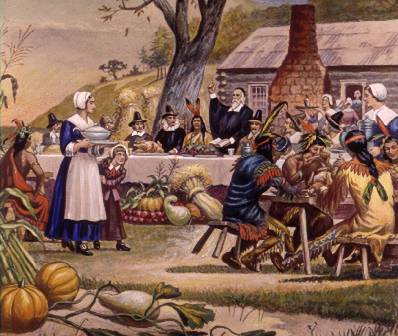
Its a nice story.
Except, in actuality, it wasn't a nice story. While some indigenous peoples certainly extended their goodwill and local knowledge to the struggling settlers, they and their descendants would soon find that any generosity to the European arrivals was sorely misplaced, as it was rewarded almost universally by violence, new diseases, displacement, and the rapid destruction of the natural resources indigenous communities relied upon for their survival.
In later years, once native populations had been sufficiently decimated to offer no threat to the new United States, we demonstrated that our goodwill could often be as destructive as our outright hostility. In an effort to "teach the savages" about that most hallowed of American traditions, Private Property, we carved up the reservations we'd just confined them to in treaties, gave them tiny parcels, and sold off the remaining land to railroad companies and white settlers. We kidnapped generations of indigenous children from their parents and forced them to abandon their languages, traditions, and cultural identities in pursuit of assimilation. We caricatured indigenous women as squaws or sex objects, and indigenous men as noble savages, alcoholic bums, or cartoon sports mascots.
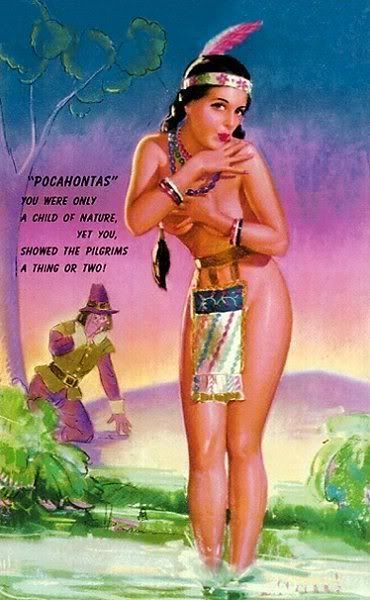

We gave one generation livestock to teach them about the agrarian lifestyle, then returned a few generations later to slaughter that livestock, chastising its owners for decimating the rangeland. We used alcohol as a weapon against them, then criticized them for not controlling their consumption. Liberals excoriate Native communities that permit logging or mining on their lands, accusing them of being "bad Indians"--- but fail to consider the crushing effects of generational poverty. Colonialism is alive and well in the U. S. of A., and brutal as ever: a mindset as much as a policy.
For many native peoples, "Thanksgiving" is observed as a National Day of Mourning, a tradition begun in 1970 when the Commonwealth of Massachusetts invited a Wampanoag leader, Frank James, to speak at a Thanksgiving event at Plymouth Rock---then uninvited him, when they learned he planned to address the oppression of American Indians.

(Indigenous activist Russell Means)
It makes sense that in the 21st century, we'd all prefer to gloss over that reality and celebrate a feel-good holiday where Indians and Pilgrims sit side by side and share things like turkey and cranberry sauce and mashed potatoes and pumpkin pipe.
Except there wasn't actually pie---
the Pilgrims didn't have enough butter or flour to make the crusts.
The "First Thanksgiving" wasn't conceived of as a new American holiday at the time---it was a celebration of a good harvest, heading into the winter--- a ritual that's been practiced by cultures that procure their own food for millenium, in every part of the world. Oddly enough, the average American family sitting down to re-enact that harvest feast has no concept of gratitude for good harvests going into winter because we are completely divorced from the production of our food. We can buy what we want to eat year-round, without having to consider the fossil fuels, suffering, genetic engineering, soil depletion, and sketchy food preservation processes that made that January tomato or cheap turkey breast possible.
Thanksgiving offers us a rich opportunity to practice gratitude in the tradition of the harvest feast. Sitting down with family and friends and sharing a meal, lovingly and intentionally prepared, is an exquisite ritual with which to express that gratitude.
First, we have to divest the ritual of the weighted Thanksgiving mythology.
Second: lets reevaluate the traditional fare. Those meat-eaters who've tasted wild or heirloom breeds of turkey express astonishment at how bland the average thanksgiving turkey tastes. I'll admit it--- I'm one of those half-assed vegetarians who's happily made exception for thanksgiving turkey in the past. Don't plan to this year, but I won't judge anyone who does choose to partake. If you are going to serve up the bird, though, please consider a few facts about the industrialized production of turkey meat in this country. In the interest of true Thanksgiving.
Farm Sanctuary reports:
Modern turkeys have been genetically manipulated to grow twice as fast, and twice as large, as their ancestors. Comparing a turkey poult’s growth rate with that of a human baby, Lancaster Farming, an agriculture newspaper, reported: “If a seven pound [human] baby grew at the same rate that today’s turkey grows, when the baby reaches 18 weeks of age, it would weigh 1,500 pounds.” The strain of growing so quickly makes young turkeys susceptible to cardiovascular disease and can lead to fatal heart attacks. Although this rapid growth poses a serious threat to the animals’ health and welfare,
 the turkey industry continues to push birds beyond their biological limits.. This continual increase in growth causes commercially-bred turkeys to suffer from crippling foot and leg problems too. According the agribusiness newspaper Feedstuffs , “...turkeys have been bred to grow faster and heavier but their skeletons haven't kept pace..." Catering to consumer tastes at the expense of animals, producers also raise turkeys with abnormally large breasts which prevent them from mounting and reproducing naturally.... Completely unlike their wild ancestors not only in terms of physique but also in hue, commercial turkeys are white, the natural bronze color bred out of them so their bodies are pigment-free and more palatable to consumers....At the slaughterhouse, fully conscious turkeys are hung by their feet from metal shackles on a moving rail. The first station on most poultry slaughterhouse assembly lines is the stunning tank, where the turkeys' heads are submerged in an electrified bath of water. Stunning procedures are not monitored, and are often inadequate, leaving the fully conscious birds to continue along the slaughterhouse assembly line. Some slaughterhouses do not even attempt to render these birds unconscious, as turkeys and other poultry are specifically excluded from the
  Humane Slaughter Act, which requires that animals be stunned prior to slaughter. After passing through the stunning tank, the turkeys' throats are slashed, usually by a mechanical blade, and blood begins rushing out of their bodies. Inevitably, the blade misses some turkeys, who then proceed to the next station on the assembly line:, the scalding tank. Here, they are submerged in boiling hot water, and turkeys missed by the killing blade are boiled alive – a brutal end to an equally miserable existence on factory farms.
If the traditional Thanksgiving story is the gravy covering up the violence of American colonialism, then the turkey is... the turkey.
Its easy to create a decadent, cruelty-free, delicious meal to share with your loved ones. In doing so, you'll be investing the celebration with potent and sustainable values. Lip-smackin' good food, rich with conscience, humanity, and ecological integrity, does everyone good, and much less harm than the traditional spread.
Even if you only replace one traditional component of your Thanksgiving feast with a sustainable, vegetarian or vegan alternative, you're taking a big step.
There's lots of ways to do this. To that end, every few days I will spotlight a tried and true vegan holiday recipe favorite from now until Thanksgiving day. In most cases, you can make your traditional favorites---mashed potatoes, stuffing---with only minor modifications, and I can guarantee you, no one will know the difference. Vegan desserts? Scrumptious, and simple, and again---hard to tell the difference! I'll dish out vegan gravy recipes, and a great way to do that green bean casserole. And, you're feeling like taking the leap: Tofurkey is nothing to fear, Its delicious, and simple to prepare.
Check out Farm Sanctuary's Adopt a Turkey program:


